Hit "Try it on me" under any cut — the style is then preselected in the tool below and all you need is a photo.

Shaved head
The most drastic option and the lowest-maintenance one: everything off, a re-shave twice a week. With an advanced receding hairline a deliberately shaved head almost always reads better than trying to redistribute thin cover. It needs a reasonably even skull shape — and sunscreen in summer.
Try it on me →

Buzz cut
One clipper guard all over, typically a #1 to #4, no gradient. A buzz hides a receding hairline better than any longer cut because it removes the contrast between hair and bare forehead. It emphasises everything else in exchange: jawline, ears, skull shape.
Try it on me →

Crew cut
Short sides, two to three centimetres on top, marginally longer at the front. This is what barbers reach for when someone says 'short, but not a buzz'. It suits fine hair particularly well, because at that length the hair stands up on its own. Re-cut every four to six weeks.
Try it on me →

Low taper fade
The gradient starts low, just above the ear, and runs cleanly down around the back. The most discreet fade variant — unremarkable in an office, still precise at the weekend, with enough length on top to style. The price of the clean look is the rhythm: after three weeks the grow-out shows.
Try it on me →

Short textured crop
Three to five centimetres on top, ends deliberately point-cut, worn forward with a matt paste. The texture makes thin hair look noticeably fuller because it breaks up how light falls. Probably the least demanding cut on this list: thirty seconds of styling and it forgives grow-out.
Try it on me →

Edgar cut
Short faded sides and a blunt, straight-cut fringe — the line across the forehead is the entire concept. The Edgar needs thick, strong hair or the edge frays, and it suits faces with defined features. With a high forehead it is one of the few cuts that deliberately shortens it.
Try it on me →

Classic side part
A defined part with the longer side combed over, smooth or lightly waved. The cut that works at forty and beyond: grown-up without being dated, right with a suit and right without one. On fine hair, dry it with some root lift or the whole thing lies flat against the skull.
Try it on me →

Curly crop
Sides short, enough length on top for the curl to form — usually four to six centimetres. The commonest mistake with curls is cutting them too short: under three centimetres a curl becomes frizz. Work a curl cream in at towel-dry and do not comb it through.
Try it on me →

Curtains / middle part
Top hair to about eyebrow length, parted in the middle, falling to both sides. The nineties are back and this is their flagship. It frames a high forehead from the sides and softens angular features. Getting the front long enough means a few unglamorous months first.
Try it on me →

Quiff
Much longer at the front, dried up and back, sides kept short. A quiff adds two to three centimetres of visible height — the most effective way to lengthen a round face. Without a dryer and a pre-styling product it collapses during the day; budget five minutes each morning.
Try it on me →
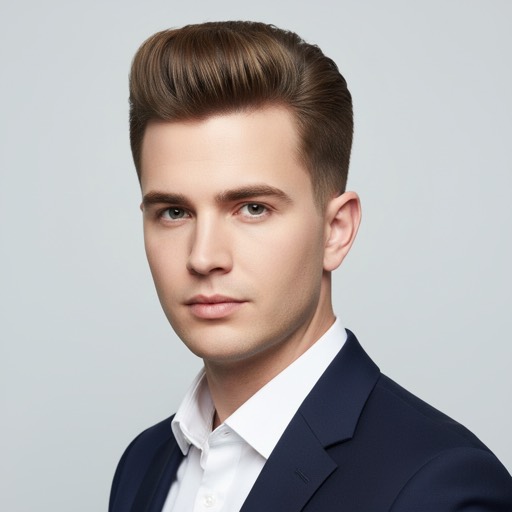
Pompadour
The quiff's bigger brother: more length at the front, the volume pulled further back, and shorter sides to compensate. A cut that announces itself, and one that assumes thick hair — fine hair will not hold the height. Pomade on towel-dried hair, then dry it into shape.
Try it on me →

Fade with beard
The gradient at the sides does not fade out but runs into the beard line — hair and beard are cut as one continuous contour. It lengthens a round face noticeably and gives a narrow jaw substance. Needs even beard growth and a barber visit every two to three weeks.
Try it on me →

Slick back
Everything backwards, smooth, held with a glossy or matt pomade. Needs at least ten centimetres on top so nothing falls forward. It exposes the entire forehead — with pronounced recession it shows everything, with clean features it looks tidier than almost any other option.
Try it on me →

Modern mullet
Short at the front and sides, long at the back — but in the current reading flowing softly into each other rather than hard-disconnected. The mullet has migrated from fancy-dress wig back into barbershops. It needs nerve and hair with some life of its own; on fine straight hair it simply hangs.
Try it on me →

Broccoli cut
Very short sides with a dense mass of short curls on top — the silhouette that named it. The younger crowd's look since around 2023. It works only with naturally curly or strongly wavy hair; it cannot be dried into straight hair.
Try it on me →

Medium-length waves
Eight to twelve centimetres, lightly layered, worn with the natural wave rather than against it. The easiest way out of the short-hair routine: no drying required, a trim every eight to ten weeks. With very fine hair the weight becomes the problem and it all lies flat.
Try it on me →

Long and flowing
Shoulder length, worn loose, minimally layered. Realistically twelve to eighteen months from a short cut, and the in-between stage from chin length is the thankless part. Which is exactly why it is worth seeing the destination on your own face before investing a year.
Try it on me →

Man bun
Needs at least fifteen centimetres for the knot to hold. The practical advantage of long hair: out of the way when it needs to be, down when you want it. Tying it very tight daily risks traction at the hairline — keep it loose and move the position around.
Try it on me →